
New Welding Fumes Standards: Australia’s 2026 Welding Fume Exposure Limits Explained
October 9, 2026 -
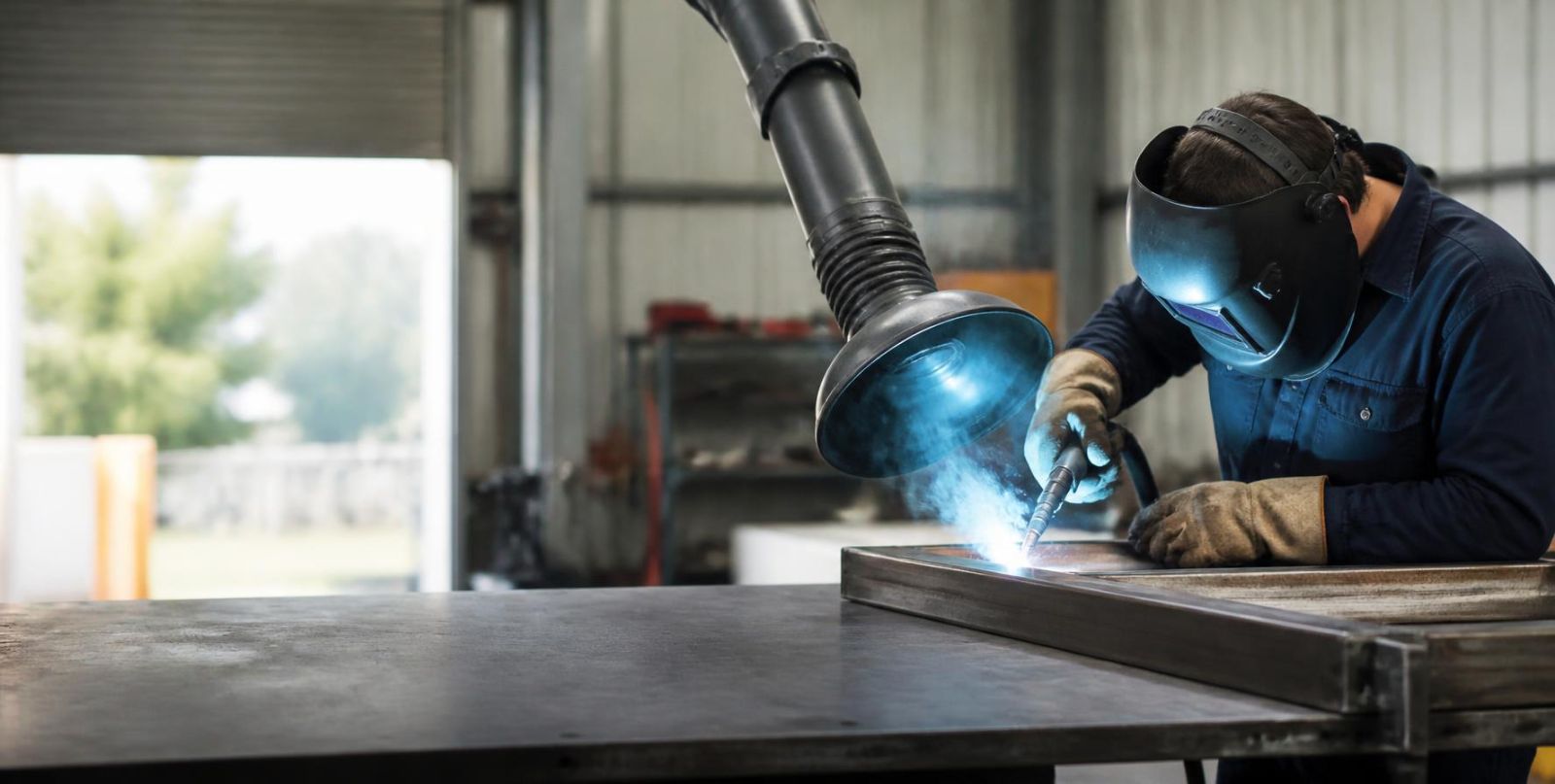
Walk into most fabrication shops and you’ll see it. Extraction arms sized years ago for mild steel MIG, now hanging over a bench full of stainless.
On 1 December 2026, the rules those arms were built for change. Australia’s welding fume exposure limits for 2026 drop hard for the metals in that fume, and one of them disappears altogether. Here’s what’s changing, what it means on the floor, and what to do before the deadline.
What Has Changed in Australia’s Welding Fume Exposure Limits for 2026
Quick answer: Welding fume (not otherwise classified) is limited to 1 mg/m³ as an 8-hour TWA, down from 5 mg/m³. From 1 December 2026, the new WEL list cuts manganese to 0.1 mg/m³ inhalable and 0.02 mg/m³ respirable, and removes chromium VI’s numerical limit entirely.
From 1 December 2026, Australia’s Workplace Exposure Standards (WES) become Workplace Exposure Limits (WEL). The new name makes the point: these are limits, not suggestions.
Total welding fume: down from 5 to 1 mg/m³
WHS ministers cut the standard for welding fumes (not otherwise classified) to 1 mg/m³ over an 8-hour time weighted average (TWA). See Safe Work Australia’s welding fume announcement for the official detail.
It also makes a point plenty of shops miss. Workers must stay under the total fume limit and under the limit for every individual component in that fume.
Aluminium welding fume: same cut
The standard for aluminium welding fume has also dropped from 5 mg/m³ to 1 mg/m³. Each state and territory adopts the change on its own date, so check with your regulator.
Manganese: a fiftyfold drop
- Current WES: 1 mg/m³.
- WEL from 1 December 2026: 0.1 mg/m³ inhalable and 0.02 mg/m³ respirable.
- Where it comes from: manganese-bearing wires, rods and fluxes used on carbon and alloy steels.
Welding fume is fine enough to reach deep into the lungs. The 0.02 mg/m³ respirable figure is the one most likely to catch out extraction that only just scraped through under the old standard.
Hexavalent chromium: no safe number
- Current WES: 0.05 mg/m³.
- From 1 December 2026: removed from the WEL list as a non-threshold genotoxic carcinogen. No exposure level is considered safe.
- Your duty: eliminate exposure where reasonably practicable, or otherwise minimise it using the hierarchy of controls.
- Where it comes from: arc welding stainless steel and high-chromium consumables.
Losing the number doesn’t loosen the rule. With no limit to measure against, you need to show what you’ve done to drive exposure down as far as reasonably practicable. The full list is in Safe Work Australia’s Workplace exposure limits for airborne contaminants.
Check your state
The WEL list applies once each jurisdiction adopts it in its laws. Victoria operates under the OHS Act 2004 and adopts the limits through its own regulations, so confirm your position with your state regulator.
Fume Controls: Work the Hierarchy Before Reaching for PPE
Quick answer: Work the hierarchy of controls: eliminate or substitute higher-fume processes and consumables first, then capture fume at the source with on-torch or local exhaust extraction. Respiratory protection backs these up wherever air monitoring shows engineering controls alone can’t keep exposure under the new limits.
Cut the fume before it starts
- Switch to lower-fume processes or consumables where the welding procedure allows it.
- Ask whether joints could be redesigned, bolted or prefabricated to reduce welding hours.
Grab it at the source
- On-torch extraction: captures fume right at the arc and moves with the welder.
- Local exhaust ventilation (LEV) arms: only work when the hood sits close to the arc. Moving it as the job moves is part of the control.
- Maintenance: blocked filters and damaged ducting quietly kill capture. Put extraction checks on the maintenance schedule.
- New extraction standard: the AS/NZS ISO 21904 series for welding fume extraction equipment was published in 2026. Ask about it when choosing new gear.
We stock welding fume extraction equipment for workshops getting ready for the new limits.
Don’t count on the roller door
Open doors and shed fans spread fume across the bay, but they don’t stop it reaching the welder’s breathing zone. They support source extraction. They don’t replace it.
Respiratory protection
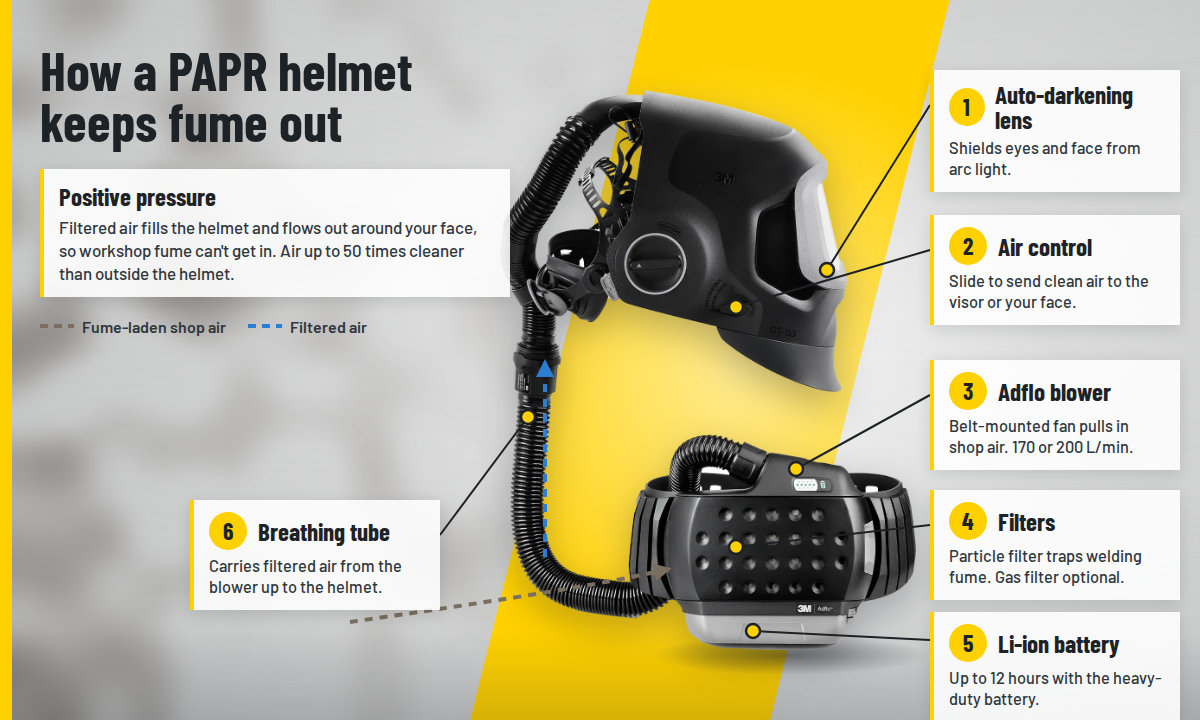
Where monitoring shows extraction alone can’t keep exposure under the limits, respiratory protection closes the gap. Powered air purifying respirator (PAPR) welding helmets supply filtered air under positive pressure and don’t rely on a face seal. That suits long shifts and welders with beards. Select and maintain all respiratory protection under AS/NZS 1715:2009.
Air Monitoring and Health Monitoring
Quick answer: Air monitoring by an occupational hygienist measures what welders actually breathe, inside the helmet. Health monitoring checks the workers themselves and is required where a risk assessment finds a significant risk from listed hazardous chemicals, such as inorganic chromium from stainless steel welding.
- Air monitoring: personal samples taken in the welder’s breathing zone and compared against the WEL list. This is how you know your controls are working.
- Health monitoring: medical checks arranged by the PCBU and supervised by a registered medical practitioner, where the WHS Regulations require it.
- Records: keep every report on file. Inspectors will ask what your decisions were based on.
Your Pre-1 December Checklist
Quick answer: Before 1 December 2026, update your hazardous chemicals register against the WEL list, arrange air monitoring for welders on stainless and manganese-bearing consumables, service or upgrade extraction, review respiratory protection, and record every control decision in your written risk assessment.
- Update your hazardous chemicals register and risk assessments against the WEL list.
- Identify which welders work on stainless, aluminium or with manganese-bearing consumables.
- Book air monitoring and keep the hygienist’s report on file.
- Inspect and service on-torch extraction and LEV.
- Review respiratory protection, fit testing and PAPR maintenance records.
- Brief welders and supervisors on what’s changed and why.
- Document every control decision for when an inspector asks.
Welding Fume Limits: What Workshops Are Asking
What is the welding fume exposure limit in Australia?
The limit for welding fume (not otherwise classified) is 1 mg/m³ as an 8-hour TWA. Individual components of the fume, such as manganese, have their own limits that you must also stay under.
When do the new welding fume limits start?
The new Workplace Exposure Limits apply from 1 December 2026. They take effect once each jurisdiction adopts them in its WHS or OHS laws. Victoria adopts them through its own regulations.
What is the new manganese exposure limit for welders?
From 1 December 2026, manganese drops to 0.1 mg/m³ inhalable and 0.02 mg/m³ respirable. The current limit is 1 mg/m³, so many workshops will need to review their extraction.
Is there still an exposure limit for hexavalent chromium?
No. From 1 December 2026, hexavalent chromium has no numerical limit because no exposure level is considered safe. You must eliminate exposure where reasonably practicable, or otherwise minimise it.
Do I need air monitoring in my welding shop?
If you aren’t sure your exposure is under the limits, yes. Under the WHS Regulations, air monitoring is required where there’s uncertainty about whether exposure exceeds an exposure limit.
Get Your Workshop Ready Before 1 December
Not sure where your shop stands? Talk to our team at Hemmant about extraction and respiratory protection that suits your welding processes. You can also browse our PAPR range for powered air welding helmets and respirator systems built for long shifts on stainless.
Have inquiries?
Give us a call on 1300 828 764 or complete the form